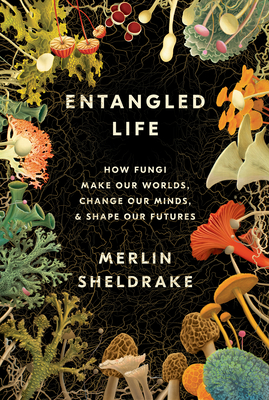
Entangled Life: How Fungi Make Our Worlds, Change Our Minds & Shape Our Futures
Overview
Sheldrake argues that fungi are vastly underestimated. Often overlooked, they play a critical role in Earth’s ecosystems, from decomposition and nutrient cycling to forming symbiotic relationships with plants (like the mycorrhizal network nicknamed the “Wood Wide Web”).
Key Concepts
Fungal Biology, A Third Kingdom
- Mycelium as organism: Fungi are neither plants nor animals; their vegetative body is the mycelium: a network of branching, tubular cells (hyphae) that can extend over vast areas. A single mycelial network can span hectares, making fungi among the largest organisms on Earth
- Hyphal growth and exploration: Hyphae grow at their tips, continuously branching and fusing (anastomosis) to form an adaptive, self-healing network; this architecture allows fungi to explore heterogeneous environments, bridge air gaps, and transport nutrients over long distances through cytoplasmic streaming
- Decomposition and the carbon cycle: Saprotrophic fungi are the planet’s primary decomposers of lignocellulose, the structural polymer of wood that almost no other organisms can break down. Without fungal decomposition, dead plant matter would accumulate indefinitely, locking up carbon and nutrients
- White-rot and brown-rot: White-rot fungi (e.g., Trametes versicolor) produce lignin peroxidases and manganese peroxidases that break down lignin; brown-rot fungi use Fenton chemistry (hydroxyl radicals from iron and hydrogen peroxide) to attack cellulose while leaving modified lignin behind
- Co-evolutionary timing: The evolution of white-rot fungi (~300 Ma) roughly coincides with the end of the Carboniferous period’s massive coal deposition, suggesting that the appearance of lignin-degrading enzymes fundamentally changed global carbon cycling
Mycorrhizal Networks, The “Wood Wide Web”
- Mycorrhizal symbiosis: Roughly 90% of plant species form mycorrhizal associations, in which fungal hyphae colonise root tissue (or surround root tips) and extend far into the soil; the fungus trades soil-derived mineral nutrients (phosphorus, nitrogen, zinc, copper) for plant-derived photosynthetic carbon (sugars and lipids)
- Arbuscular mycorrhizae (AM): The most ancient and widespread type (~400 million years old); fungal hyphae penetrate root cell walls and form highly branched structures (arbuscules) where nutrient exchange occurs across a thin interfacial membrane
- Ectomycorrhizae (ECM): Common in temperate and boreal forests (oaks, pines, birches); hyphae form a sheath around root tips and a Hartig net between root cells; many ECM fungi produce the familiar mushroom fruiting bodies
- Inter-plant resource transfer: Mycorrhizal networks can connect different individual plants, even different species, enabling the transfer of carbon, nitrogen, phosphorus, water, and chemical defence signals between them; Sheldrake discusses the evidence and controversies around so-called “mother trees” that subsidise seedlings through shared fungal connections
- Signalling: Mycorrhizal networks may transmit chemical alarm signals (e.g., jasmonic acid pathway activation) from attacked plants to neighbours, priming their defences before herbivores arrive
Lichens and the Boundaries of Individuality
- Composite organisms: Lichens are stable symbioses between a fungus (the mycobiont) and one or more photosynthetic partners (algae or cyanobacteria, the photobiont); recent research has revealed that many lichens also harbour yeasts and bacteria as integral partners, challenging the classical two-partner model
- Questioning individuality: Sheldrake uses lichens as a case study to question where one organism ends and another begins, a theme he extends to all symbioses. If a lichen is not “one thing” but a community, what does that say about trees reliant on mycorrhizal fungi, or animals reliant on gut microbes?
Human Uses and Radical Mycology
- Fermentation: Yeasts (fungi) produce bread, beer, wine, soy sauce, miso, and countless other fermented foods; Sheldrake frames fermentation as one of humanity’s oldest and most consequential biotechnologies
- Psychedelics and neuroscience: Psilocybin (produced by Psilocybe and related genera) is a tryptamine that is converted to psilocin in the body, agonising serotonin 5-HT₂A receptors; clinical trials show efficacy for treatment-resistant depression, addiction, and end-of-life anxiety, raising questions about why fungi produce a compound that so profoundly alters mammalian consciousness
- Mycoremediation: Fungi can degrade or sequester environmental pollutants, PAHs (polycyclic aromatic hydrocarbons), pesticides, heavy metals, and even some plastics, using the same enzymatic machinery evolved for breaking down complex plant polymers; Sheldrake discusses real-world remediation projects and the promise (and limitations) of deploying fungi for environmental clean-up
- Myco-materials: Mycelium can be grown on agricultural waste into lightweight, biodegradable composites used for packaging, insulation, and leather alternatives, part of a broader movement to use fungal biology as a platform for sustainable manufacturing
Personal Reflection
As fascinating as the biology is, Sheldrake’s book is also on the philosophical implications of fungal life. It challenges anthropocentric and plant-centric views of the world, inviting readers to consider a more networked, interdependent view of life. While I did not know or learn much more about the biology and ecology beforehand, it was a good starting point to wonder and learn more about the hidden networks that sustain life on Earth.
Related Books
- Fungipedia - Millman’s compendium provides the taxonomic breadth that complements Sheldrake’s narrative depth
- The Secret Network of Nature - Wohlleben describes ecosystem cascades that depend on the fungal networks Sheldrake explores mechanistically
- I Contain Multitudes - Both challenge individual-organism thinking, Yong with microbes, Sheldrake with fungi
Parent: Books