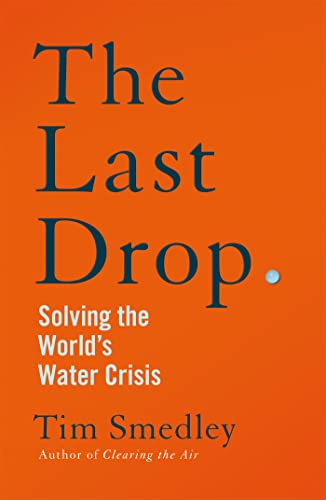
The Last Drop: Solving the World’s Water Crisis
Overview
The Last Drop by Tim Smedley explores the global water crisis, arguing that the issue isn’t a lack of water on Earth but rather how humans mismanage and distribute it.
Key Concepts
The Water Cycle Under Stress
- Not running out — being mismanaged: Smedley’s central thesis is captured in his opening line: “The world isn’t running out of water — people are.” The total volume of water on Earth is fixed (~1.4 billion km³), but only ~0.5% is accessible freshwater. The crisis is one of distribution, timing, contamination, and governance — not absolute scarcity
- Climate amplification: As global temperatures rise, the water cycle intensifies — warmer air holds ~7% more moisture per degree Celsius (Clausius–Clapeyron relation), leading to more intense precipitation events in wet regions and more severe evaporative drought in dry regions. The result is not “more water” but more extreme variability — longer droughts punctuated by more destructive floods
- Water vapour feedback: Increased atmospheric water vapour is itself a potent greenhouse gas, creating a positive feedback loop — warming → more evaporation → more water vapour → more warming
Mismanagement of Water Resources
- Over-extraction of aquifers: Groundwater is being pumped far faster than natural recharge rates — the Ogallala Aquifer (US Great Plains), the North China Plain aquifer, and aquifers under the Indo-Gangetic Plain are all in severe decline. Many aquifers took thousands of years to fill and are functionally non-renewable on human timescales
- Subsidence: When an aquifer is emptied, the geological formation above can physically collapse — subsidence is irreversible, permanently reducing the aquifer’s storage capacity. Mexico City has sunk over 10 metres in some areas; Jakarta is sinking so fast that Indonesia is relocating its capital
- Dams and river engineering: Large dams (there are ~60,000 worldwide) fragment rivers, block sediment transport (starving deltas and coastlines), disconnect floodplains from their rivers (destroying wetland ecosystems), alter downstream temperature and flow regimes, and trap nutrients. While they provide hydropower, irrigation, and flood control, their cumulative ecological cost is enormous
- Desalination: Energy-intensive (~3–4 kWh/m³ for reverse osmosis) and produces toxic brine concentrate that harms marine ecosystems when discharged; viable as a last resort but not a systemic solution without clean energy and brine management
- Pollution: Agricultural runoff (nitrogen and phosphorus from fertilisers, pathogens from manure) drives eutrophication and algal blooms that create hypoxic dead zones; pharmaceutical residues, microplastics, and PFAS (“forever chemicals”) are increasingly detected in water supplies worldwide and are poorly removed by conventional treatment
Solutions and Innovations
- Agricultural reform: Agriculture consumes ~70% of global freshwater withdrawals; the largest gains lie here. No-till farming and cover cropping improve soil structure and water-holding capacity (the “soil sponge” effect); drip irrigation reduces water use by 30–70% compared to flood irrigation; and crop diversification and rotation reduce nutrient runoff
- Economic instruments: Tiered water pricing (higher tariffs for higher consumption) incentivises conservation and reflects the true cost of supply; water markets can allocate scarce resources more efficiently — but Smedley warns that full commodification of water raises equity concerns, as access to clean water is a human right
- Rainwater harvesting and reuse: Capturing rainwater at source (rooftop collection, permeable surfaces, urban retention ponds) reduces pressure on mains supply and groundwater, attenuates flood peaks, and is effective even at household scale in arid regions. Treated wastewater reuse (for irrigation, industrial cooling, even potable reuse via advanced treatment) is gaining traction — Singapore’s NEWater programme reclaims ~40% of the nation’s water demand from treated sewage
- Nature-based solutions: Smedley argues these are the most underused and cost-effective interventions
- Wetland restoration: Wetlands filter pollutants, attenuate floods, recharge aquifers, and support biodiversity; yet ~85% of global wetlands have been lost since 1700. Restoring them provides water-management benefits that engineered infrastructure often cannot match
- Beaver reintroduction: Beavers build dams that slow water flow, raise water tables, create ponds that serve as natural reservoirs and fire breaks, filter sediment and nutrients, and dramatically increase habitat complexity — a single beaver family can transform a degraded stream into a functioning wetland ecosystem
- Removing invasive species: Water-hungry non-native plants (e.g., eucalyptus plantations in South Africa, saltcedar in the American Southwest) can consume disproportionate volumes of water; targeted removal restores natural flow regimes and aquifer recharge
Personal Reflection
Overall very interesting insights into water management, although it can be heavy and overdone in terms of statistics and policy. I think Tim Smedley captured the problem at its core in the introduction “The world isn’t running out of water - people are.”
Related Books
- Clearing the Air - Same author, same urgency: air and water as companion environmental crises
- The Blue Machine - Czerski explains the physical water cycle Smedley shows humans are disrupting
- Dirt to Soil - Brown’s regenerative agriculture directly addresses the water-cycle damage Smedley documents
Parent: Books