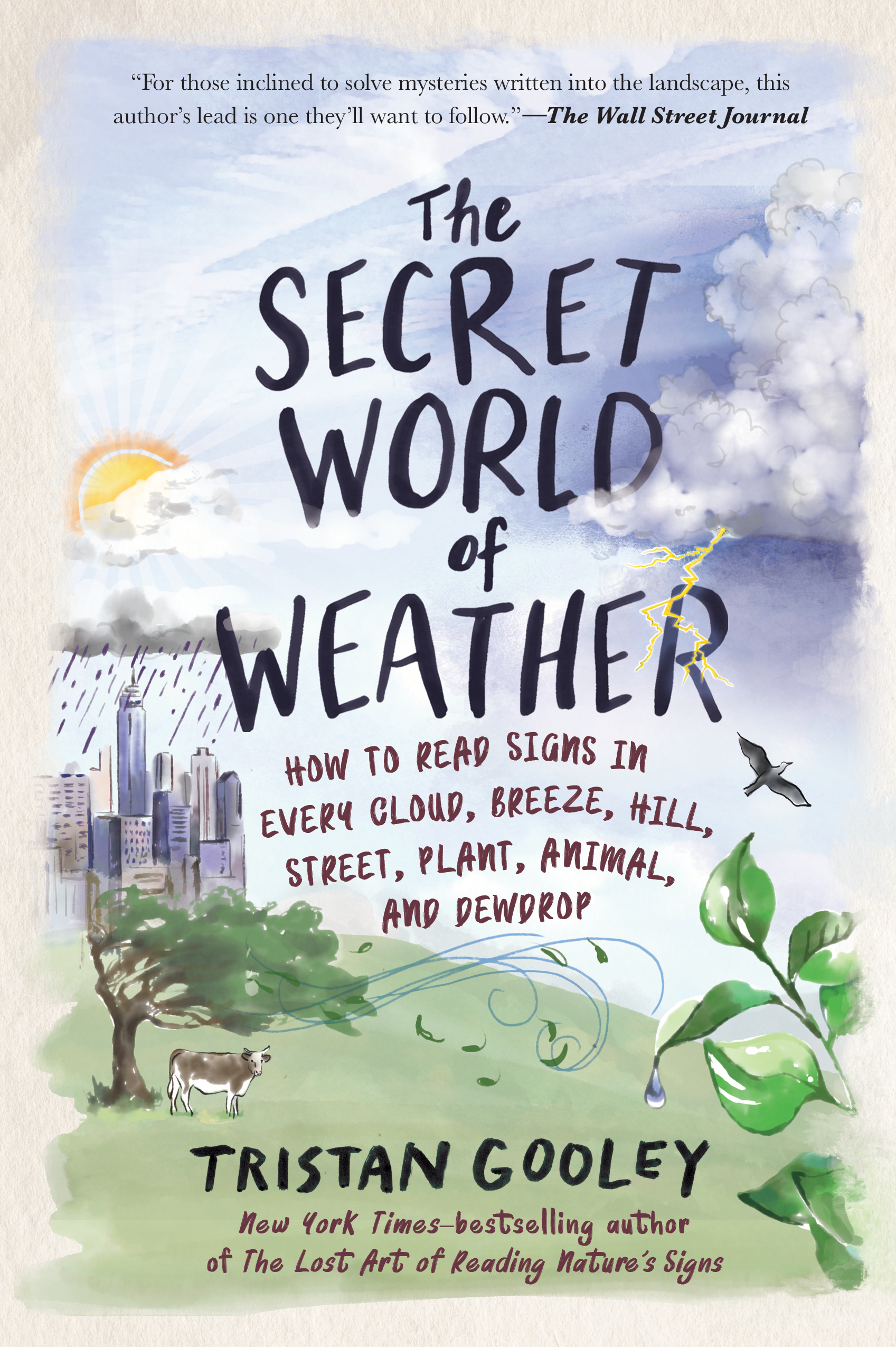
The Secret World of Weather
Overview
Tristan Gooley teaches readers to read weather at the hyper-local scale — not from satellite images or forecasts but from direct observation of clouds, wind, light, plants, and terrain. The book argues that weather is not a single phenomenon experienced uniformly across a region but a patchwork of micro-climates created by the interaction of atmospheric processes with local topography, vegetation, and water bodies. Gooley combines meteorological science with the field-craft of a natural navigator, providing practical rules for predicting what the sky will do in the next minutes to hours based on sensory cues available to anyone standing outdoors.
Key Concepts
Cloud Reading
- Cloud taxonomy and forecasting — cumulus, stratus, and cirrus families each signal different atmospheric conditions; towering cumulonimbus indicates strong convective uplift and imminent thunderstorms, while a thickening sequence of cirrus → cirrostratus → altostratus often heralds an approaching warm front and sustained rain
- Lenticular and orographic clouds — lens-shaped clouds forming over mountains reveal standing waves in the airflow; their presence indicates strong winds aloft even when the surface is calm, and their persistence or dissolution signals changes in atmospheric stability
- Cloud streets and convective cells — parallel rows of cumulus aligned with the wind indicate organised convection in the boundary layer; their spacing is proportional to the depth of the convective layer
Wind, Pressure, and Frontal Systems
- Buys Ballot’s law in practice — standing with your back to the wind in the Northern Hemisphere, low pressure lies to your left; Gooley translates this into a field-usable rule for estimating where storm centres are relative to the observer
- Frontal passage cues — a warm front brings gradual cloud thickening, steady rain, and a veering wind; a cold front brings abrupt temperature drops, gusty winds, and heavy showers followed by clearing — recognisable sequences that allow real-time forecasting
- Katabatic and anabatic winds — at night, cooled air drains downhill (katabatic), pooling in valleys as frost pockets; by day, sun-warmed slopes generate uphill breezes (anabatic) that can trigger afternoon cumulus formation over ridgelines
Micro-Climates and Landscape Effects
- Rain shadows — mountains force moist air upward, causing precipitation on the windward side and leaving the leeward side significantly drier; Gooley shows how even modest hills create measurable micro-rain-shadows
- Urban heat islands — cities retain heat through concrete thermal mass and reduced evapotranspiration, creating local temperature anomalies of several degrees and altering convection patterns
- Vegetation as weather indicator — trees shaped by prevailing wind (flagging), lichen growth patterns on rocks, and the opening/closing behaviour of certain flowers provide biological proxies for local climate conditions
Light, Colour, and Atmospheric Optics
- Red sky at night — the proverb encodes real physics: a red sunset means the western sky is clear and dry air is approaching, while a red sunrise means the clear air has passed and moisture-laden air is moving in from the west
- Coronae and halos — rings around the sun or moon caused by ice crystals (halos) or water droplets (coronae) indicate specific cloud types and humidities, providing forecasting information about frontal approach and precipitation likelihood
Personal Reflection
[To be added]
Related Books
- The Blue Machine - Talley provides the oceanic counterpart to Gooley’s atmospheric patterns
- The Primacy of Doubt - Palmer explains the physics and chaos behind the weather patterns Gooley reads
- Geopedia - Marais covers Earth-system concepts that overlap with Gooley’s micro-weather
Parent: Books