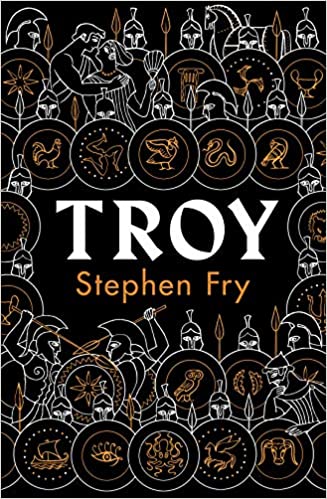
Troy
Overview
Stephen Fry retells the saga of the Trojan War from its mythological origins to the fall of the city and beyond, weaving together strands from Homer, Virgil, the Epic Cycle, and later classical sources into a single continuous narrative. Unlike retellings restricted to the Iliad’s timeframe, Fry covers the full arc: the golden apple of Discord, the judgement of Paris, the gathering of the Greek host, a decade of siege, the stratagem of the wooden horse, and the fates of the survivors. The book balances fidelity to the source myths with Fry’s characteristic wit, making the characters’ motivations and moral ambiguities accessible to modern readers.
Key Concepts
The Mythological Prelude
- The Judgement of Paris — the war’s ultimate cause is traced to a beauty contest among Hera, Athena, and Aphrodite, adjudicated by the Trojan prince Paris; his choice of Aphrodite (who promised him the most beautiful woman in the world) set in motion the abduction of Helen and the geopolitical crisis that followed
- Oaths and obligations — the Oath of Tyndareus bound all of Helen’s former suitors to defend the marriage of whoever won her hand, transforming a personal slight into a pan-Hellenic military obligation and revealing how honour-codes create binding, escalatory commitments
- Prophecy and fate — figures like Cassandra (cursed to prophesy truly but never be believed) and Calchas embody the Greek tension between foreknowledge and free will: characters know what will happen yet cannot act to prevent it
The Siege and Its Heroes
- Achilles — aristeia and mēnis — the central dramatic engine is Achilles’ wrath (mēnis): his withdrawal from battle over a slight by Agamemnon, the devastating consequences for the Greek army, and his return driven by grief for Patroclus, illustrating the destructive power of unchecked honour
- Hector — duty versus doom — Hector fights not for glory but for family and city, knowing Troy is fated to fall; his death at Achilles’ hands and the desecration of his body crystallise the tragedy of the losing side
- Odysseus — mētis over biē — cunning intelligence (mētis) complements brute force (biē); Odysseus’ schemes (the wooden horse, the theft of the Palladium) ultimately achieve what ten years of combat could not
Divine Intervention and Moral Ambiguity
- Gods as partisan actors — Fry faithfully portrays the Olympians intervening directly in battle (Aphrodite rescuing Paris, Apollo guiding the arrow that kills Achilles), showing that the Greek concept of heroism operates within a cosmos where human agency is always partially constrained by divine will
- Moral complexity — neither side is wholly heroic or villainous; Agamemnon sacrifices his daughter Iphigenia, the Greeks slaughter Trojan infants, and even sympathetic figures commit atrocities, reflecting the Greek understanding of war as inherently corrupting
- Hospitality (xenia) violated — Paris’s abduction of Helen from Menelaus’s house is framed as a sacrilege against xenia (guest-friendship), one of the most sacred obligations in Greek ethics, making the war a cosmic correction as much as a political conflict
Legacy and Resonance
- The Epic Cycle beyond Homer — Fry draws on the Cypria, Little Iliad, Iliou Persis, and other lost epics to fill gaps Homer left, providing a complete narrative arc that shows how many “Trojan War” stories most people know actually come from non-Homeric sources
- Archetypes and cultural endurance — characters like the doomed warrior (Achilles), the faithful wife (Penelope), and the trickster-hero (Odysseus) became foundational Western literary archetypes, recurring in Roman, medieval, and modern literature
Personal Reflection
[To be added]
Related Books
- Mythos - Fry’s Greek-myth overview; Troy zooms in on the war at the centre of those myths
- Heroes - Fry’s character-driven companion; many heroes reach their fate at Troy
- The Iliad - Homer’s original source for the siege Fry retells
Parent: Books