Elements of Eloquence
Overview
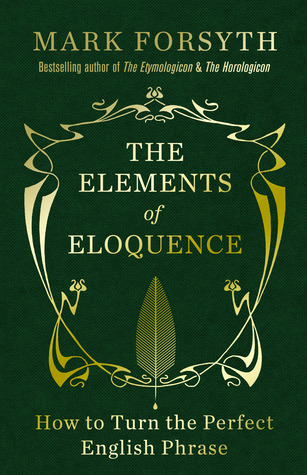
Forsyth walks through a long series of rhetorical figures (aposiopesis, chiasmus, syllepsis, anadiplosis, isocolon and many more), one per chapter. Each is explained with a short definition and a stream of examples ranging from Shakespeare and the Bible to speeches, advertising slogans and contemporary movie lines. The main argument is that memorable phrases are rarely accidents: they follow patterns that have been named and catalogued for over two thousand years, and anyone can learn to use them.
Note that the book itself does not cluster the figures into groups, and it says little about why they work in the mind. The clusters below are my own synthesis, built on my reading of Pinker and Deutscher. They are a personal framework, not Forsyth’s structure and not an established taxonomy, and the cognitive explanations are plausible hypotheses rather than settled findings. They are also based on my perspective of predictive coding and how the brain anticipates and processes (linguistic) input.
Key Concepts
Classical framing: schemes and tropes
The oldest and most common clustering in rhetoric splits figures into two families.
- Schemes: figures that change the arrangement or pattern of words (order, repetition, balance, sound, rhythm). Almost everything in my notes is a scheme.
- Tropes: figures that change the meaning of words (metaphor, metonymy, irony, oxymoron). Forsyth covers few of these, so my clusters below are scheme-heavy.
- Figures of thought: a looser third category that acts on the audience’s attitude or the argument itself (rhetorical questions, aposiopesis).
My four clusters are organized by the cognitive function a figure serves. They are non-exhaustive, and many figures belong to more than one cluster (chiasmus sits in at least three).
1. Syntax and structure (easing or taxing the parse tree)
- Core idea: the brain builds a hierarchical syntax tree in working memory while it reads or listens. Figures in this group either lighten that load or deliberately play with it.
- Isocolon: clauses of equal length and shape. After the first clause, the listener can predict the template of the second, so parsing costs almost nothing. E.g. “Easy come, easy go.”
- Antithesis: parallel syntax plus opposed meaning. With the structure predictable, attention goes entirely to the contrast. E.g. “To err is human, to forgive divine.”
- Chiasmus: the A B B A mirror. It closes the structure like a loop, which makes it tidy to parse and easy to remember. Forsyth’s examples run from logical and grammatical chiasmus down to vowel and assonance chiasmus. E.g. “Ask not what your country can do for you, ask what you can do for your country.” Or, at word level: “Never let a fool kiss you, or a kiss fool you.”
- Parataxis vs hypotaxis: flat, coordinated clauses give a shallow tree and a feeling of simplicity and speed. Nested, subordinated clauses give a deep tree that maps cause, condition and time, and feel complex. E.g. parataxis: “I came, I saw, I conquered.” Hypotaxis: “When the train, which had been delayed, finally arrived, we left.”
- Syllepsis: one word governing two others in different senses (“lost her keys and her temper”). It forces a quick re-parse mid-sentence, and the small jolt reads as wit. E.g. “He took his hat and his leave.”
2. Audience participation (pragmatics and inference)
- Core idea: language is dialogue, not just transfer of information. These figures withhold something explicit, so the audience has to do part of the work, and what we complete ourselves tends to feel more convincing and memorable.
- Aposiopesis: breaking off mid-sentence. The listener finishes the thought, usually with something worse than the speaker would have said. E.g. “If you do that one more time…”
- Rhetorical questions: a statement disguised as a question. The listener silently supplies the answer and becomes a co-author of the point. E.g. “If you prick us, do we not bleed?“
3. Sound and rhythm (phonology and prosody)
- Core idea: language is older as sound than as text, and the ear rewards pattern. Repeated sounds bind words into one unit, and predictable stress creates anticipation and release.
- Alliteration, assonance, consonance: repeated consonants or vowels act as auditory glue, so a phrase is processed and stored as a single chunk. E.g. alliteration: “Peter Piper picked a peck of pickled peppers.” Assonance: “The rain in Spain stays mainly in the plain.” Consonance: “struts and frets his hour upon the stage.”
- Meter (iamb, trochee, anapaest, dactyl): regular stress patterns make speech feel natural, musical or authoritative. The brain predicts the next beat, and a satisfied prediction feels pleasant.
- Iamb (da-DUM): “Shall I compare thee to a summer’s day”
- Trochee (DUM-da): “Tyger Tyger, burning bright”
- Anapaest (da-da-DUM): “‘Twas the night be-fore Christmas”
- Dactyl (DUM-da-da): “Half a league, half a league”
4. Repetition and linkage (memory and coherence)
- Core idea: repeated material is cheap to process and easy to recall, and it signals how one idea connects to the next.
- Anadiplosis: ending a clause with the word that begins the next (“fear leads to anger, anger leads to hate”). It chains ideas so the listener can follow the logic step by step. E.g. “Suffering produces perseverance; perseverance, character; and character, hope.”
- Anaphora, epistrophe and relatives: repetition at the start or end of clauses. They create a frame the audience can predict and remember. E.g. anaphora: “We shall fight on the beaches, we shall fight on the landing grounds.” Epistrophe: “of the people, by the people, for the people.”
Personal Reflection
I enjoyed this book much more because I had read Deutscher and Pinker first. Those two deconstruct language into logical parts and explain how and why it is the way it is. Forsyth then works as the practical guide: a list of figures that do well in general, which suddenly makes sense in light of that theory (parse trees, working memory, the oral origins of language, metaphor and erosion in language change).
The book itself is fun and light. It is packed with examples from Shakespeare to contemporary movie lines, but it barely explains why they work well in the human brain. That is not his goal, and he doesn’t pretend otherwise. My verdict is that it is best read as one part of a larger linguistic, or even psycholinguistic, picture rather than on its own. The clustering above is my attempt to supply the missing “why”.
Related Books
- The Sense of Style - Pinker on how the mind parses sentences and why clear style works; the source of my syntax and parsing cluster.
- The Unfolding of Language - Deutscher on how grammar and vocabulary evolve through erosion, reanalysis and metaphor; the backdrop for thinking about why figures exist at all.
- Ondraaglijke Lichtheid - Pfeijffer goes into irony which is on the trope aspect of rhetorics, which Forsyth not deeply covers.
Parent: Books