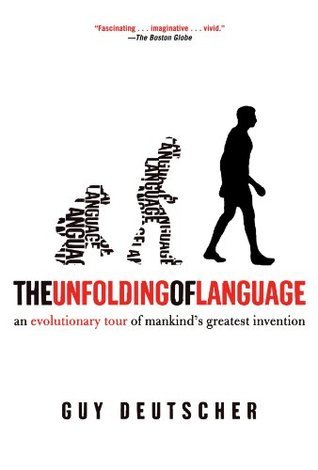
The Unfolding of Language
Overview
The Unfolding of Language argues that language is mankind’s greatest invention, despite the fact that it was never consciously designed. By exploring the complex, often chaotic, and seemingly random processes of linguistic change, Deutscher explains how intricate structures like the Semitic verb system, verb conjugations, and noun cases arose naturally. Escaping the rigid “nature vs. nurture” debate, the book highlights how language constantly evolves and renews itself through three main forces: economy (saving effort), expressiveness (the need for effect), and analogy (the mind’s search for patterns).
Key Concepts
The Illusion of Design
- Complexity without an architect: Language features profound complexity, such as the Semitic root system (e.g., s-l-m for Islam, salam, Muslim), gendered nouns, and myriad irregularities, but no one deliberately designed it.
- Continuous change vs. decay: For millennia (even dating back to Cicero), people have lamented the “decay” of language. However, this perceived decay is merely the continuous process of linguistic evolution, driven by combined forces of destruction and creation.
The Forces of Linguistic Evolution
- Economy (Saving Effort): Pronunciation naturally erodes to save physical effort, dropping syllables or weakening stop consonants into fricative sounds (e.g., Grimm’s Law, or everyday shortcuts like pronouncing “cupboard” as “cubberd”). The more common a word, the more its sound gets shortened.
- Expressiveness (Inflation): People constantly seek more expressive ways to communicate. However, frequent use causes “inflation,” reducing the emotional impact or meaning of words, necessitating the creation of new expressive terms (e.g., using words like “awesome” or “terribly” to simply mean “very”, because the original words lost their punch).
- Analogy (Finding Order): Language must be re-learned afresh by every new generation. As speakers search for regular patterns, they often impose order where there was none, extending perceived patterns across the vocabulary (e.g., children intuitively saying “foots” instead of “feet,” or creating the verb “edit” from the noun “editor”).
Creation Through Destruction and Metaphor
- Concrete to abstract: Metaphors are the engine of new meaning, transferring terms from the concrete domain (grounded in physical experience, like body parts or spatial relations) to abstract domains (like time and logical reasoning). Over time, the original literal meaning may be completely forgotten (e.g., using spatial concepts for time, like “looking forward” to the future or falling behind schedule).
- The grammaticalization process: Complex grammatical structures, such as cases, verb conjugations, and future tenses, originate as combinations of standalone words. Through high frequency of use, they are concatenated, eroded by economy, and eventually fused into a single new form (e.g., the physical movement in “going to” eroding into the future tense marker “gonna”). It may be that even the Latin case system arose from the fusion of prepositions with nouns, rather than being a designed feature of the language, as well as the Semitic root system arising from the fusion of consonantal roots with vowel patterns.
- The ‘Me Tarzan’ stage: Tracing language back to its origins reveals a starting point of simple “thing” or “action” words. Innate cognitive rules, such as ordering events as they happen, placing the most relevant information first, and associating things that appear together in reality, guided early syntax before modern grammar evolved.
Modern Constraints on Evolution
- Frequency dictates grammar: Grammar essentially codes what a language has to do most often. This perfectly aligns with principles of information theory: the most frequently communicated concepts undergo the most compression, so, phonetic erosion, eventually solidifying as compact grammatical rules. The more common a word or grammatical necessity, the more it can be shortened without losing its communicative power.
- Societal scale and simpler morphology: Intricate morphological systems (like complex noun cases) tend to flourish in small, isolated communities where rapid linguistic changes can take hold. As societies become larger and more interconnected, their languages naturally trend toward simpler morphology. Globalization limits the isolation required for radical grammatical restructuring.
- Writing as an anchor: Historically, erosion and grammaticalization flowed freely in purely spoken languages. Today, widespread literacy and standardized writing define spelled language over phonetics, creating an anchor that blocks the natural erosion that otherwise drives evolution.
Personal Reflection
An absolute must-read for anyone interested in the history and evolution of language. Deutscher’s writing is clear, engaging, and accessible, making complex linguistic concepts understandable to a general audience. Each chapter and section adds a piece to the puzzle, a mechanism, a vector of change, and examples that illustrate what happens in recent history and what likely happened in the distant past. The book provides a fascinating perspective on how language evolves through natural processes rather than deliberate design, challenging common misconceptions about linguistic decay. It also highlights the dynamic interplay between economy, expressiveness, and analogy in shaping the languages we speak today.
Related Books
- The Language Instinct by Steven Pinker - Covers the innate biological aspects of language, contrasting with Deutscher’s focus on cultural evolution.
- Proto by Spindley - Explores the origins of language, mapping back to Deutscher’s early “Me Tarzan” stage of human communication.
- The Sense of Style by Steven Pinker - Relates to clear communication and how modern language continues to change and function effectively.
- Ondraaglijke Lichtheid by Ilja Leonard Pfeijffer - How irony changes language and meaning, catching the evolution of language in the act
Parent: Books