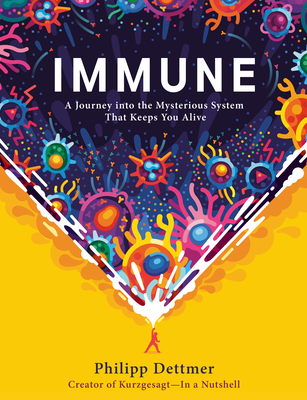
Immune: A Journey into the Mysterious System that Keeps You Alive
Overview
Philipp Dettmer (creator of the Kurzgesagt YouTube channel) provides a comprehensive tour of the human immune system, explaining how billions of cells coordinate to defend the body against pathogens, manage tissue damage, and maintain internal equilibrium. The book moves from the physical and chemical barriers of innate immunity through the sophisticated antigen-specific responses of adaptive immunity to the pathologies that arise when the system misfires. Dettmer’s visual, analogy-rich style makes one of biology’s most complex systems accessible without sacrificing mechanistic accuracy.
Key Concepts
Innate Immunity — The First Line of Defence
- Physical and chemical barriers — skin, mucous membranes, stomach acid, and antimicrobial peptides (defensins, lysozyme) prevent most pathogens from entering the body; these barriers are non-specific and always active
- Phagocytes — macrophages and neutrophils engulf and digest pathogens through phagocytosis; macrophages also serve as sentinels that detect danger signals (PAMPs, DAMPs) via pattern-recognition receptors (Toll-like receptors)
- The complement system — a cascade of ~30 plasma proteins that tag pathogens for destruction (opsonisation), punch holes in bacterial membranes (membrane attack complex), and amplify inflammatory signalling
- Natural killer cells — NK cells patrol for body cells that display abnormal surface markers (e.g. missing MHC-I), enabling them to kill virus-infected or cancerous cells without prior sensitisation
Inflammation — The Alarm System
- Purpose and mechanism — tissue damage triggers the release of cytokines and chemokines that dilate blood vessels (redness, heat), increase permeability (swelling), and recruit immune cells to the site of infection
- The cytokine network — interleukins, interferons, and tumour necrosis factor coordinate communication between immune cells; Dettmer explains how this signalling network can amplify responses precisely but also spiral into dangerous positive feedback loops (cytokine storms)
- Resolution — anti-inflammatory signals (IL-10, TGF-β, resolvins) actively shut down inflammation once the threat is cleared, preventing chronic tissue damage
Adaptive Immunity — Precision and Memory
- T cells — helper T cells (CD4+) orchestrate immune responses by activating B cells and cytotoxic T cells; cytotoxic T cells (CD8+) kill infected cells by recognising pathogen-derived peptides presented on MHC-I molecules
- B cells and antibodies — each B cell produces a unique antibody shape generated by V(D)J recombination; upon encountering a matching antigen, B cells proliferate and differentiate into plasma cells that flood the body with antibodies that neutralise, opsonise, or agglutinate pathogens
- Immunological memory — after an infection is cleared, a subset of T and B cells persist as memory cells; upon re-exposure, they mount a faster, stronger response — the principle underlying vaccination
- Clonal selection and tolerance — only lymphocytes whose receptors match a foreign antigen are activated and expanded (clonal selection); self-reactive cells are eliminated during development in the thymus (T cells) or bone marrow (B cells) to prevent autoimmunity
When the System Fails
- Autoimmunity — when self-tolerance breaks down, the immune system attacks the body’s own tissues (type-1 diabetes, rheumatoid arthritis, multiple sclerosis); Dettmer explains how molecular mimicry and regulatory T cell failure contribute
- Allergies and hypersensitivity — IgE-mediated responses to harmless antigens (pollen, food proteins) trigger mast cell degranulation, releasing histamine and causing symptoms from hay fever to anaphylaxis
- Immunodeficiency — whether genetic (SCID) or acquired (HIV destroying CD4+ T cells), immune deficiency leaves the body vulnerable to opportunistic infections that a healthy system would easily control
Personal Reflection
[To be added]
Related Books
- I Contain Multitudes - The microbiome is the immune system’s constant negotiation partner
- The Song of the Cell - Mukherjee explores the cells (T-cells, macrophages) Dettmer describes at the system level
- The Secret Body - Davis covers recent immunology breakthroughs extending Dettmer’s story
Parent: Books