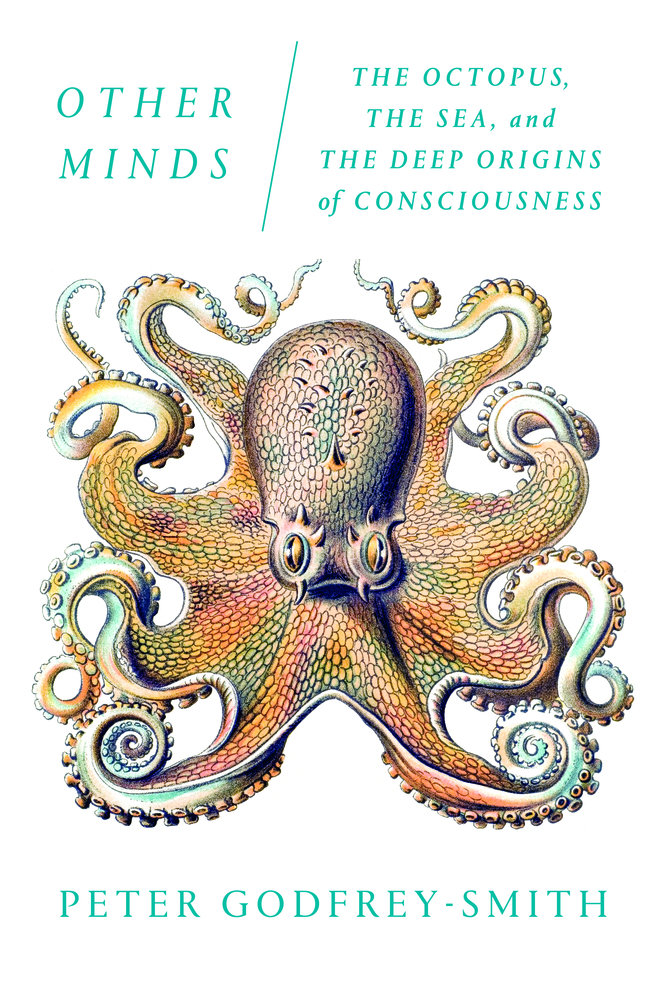
Other Minds: The Octopus, the Sea, and the Deep Origins of Consciousness
Overview
In Other Minds, philosopher of science Peter Godfrey-Smith uses the octopus as a lens to explore the evolution of consciousness. Cephalopods and vertebrates diverged over 500 million years ago, meaning that any complex cognition in octopuses evolved independently of our own. If octopuses are conscious, consciousness has been “invented” at least twice — making them the closest thing to intelligent aliens we can study on Earth. The book weaves together evolutionary biology, neuroscience, and philosophy of mind.
Key Concepts
Divergent Evolution of Nervous Systems
- The Ediacaran split: The last common ancestor of cephalopods and vertebrates was a small, worm-like creature with a very simple nervous system (~600 million years ago). Everything complex about octopus cognition evolved on a completely separate branch from ours.
- Distributed nervous system: Two-thirds of an octopus’s ~500 million neurons reside in the arms, not the central brain. Each arm can taste, touch, and initiate local motor programs semi-autonomously, while the central brain coordinates higher-level goals.
- Independent eye evolution: Cephalopod eyes evolved convergently with vertebrate eyes (camera-type lens) but with different engineering — no blind spot, different retinal wiring — showing that selection pressure for vision is strong enough to produce similar solutions independently.
Cephalopod Intelligence
- Problem-solving and play: Octopuses navigate mazes, open jars, use tools (coconut-shell shelters), and engage in apparent play behavior (repeatedly blowing objects into water currents), all indicators of flexible cognition rather than rigid instinct.
- Short lifespan paradox: Most octopuses live only 1-2 years, raising the question of why evolution invested in such a large, expensive nervous system for so brief a life. One hypothesis: their soft, shell-less bodies require rapid, flexible behavioral responses to predators, driving neural complexity.
- Color-blind camouflage: Octopuses produce extraordinary camouflage by controlling millions of chromatophores in their skin, yet they appear to be color-blind. The mechanism may involve light-sensitive proteins (opsins) distributed in the skin itself, sensing light independently of the eyes.
Consciousness Beyond Vertebrates
- Subjective experience in cephalopods: Godfrey-Smith asks whether there is “something it is like” to be an octopus. The behavioral sophistication, responsiveness to pain, and individual personality variation suggest yes — though the character of that experience may be profoundly alien.
- The body as mind: Because the octopus nervous system is so distributed, the boundary between “brain” and “body” blurs. This challenges the centralized-brain model of consciousness and resonates with embodied cognition theories.
- Convergent consciousness: If consciousness evolved independently in cephalopods and vertebrates, it suggests that subjective experience may be a reliable product of neural complexity rather than a one-off accident — an encouraging (if speculative) conclusion for the search for consciousness elsewhere in nature.
Personal Reflection
[To be added]
Related Books
- An Immense World - Both explore non-human consciousness through radically different sensory/neural architectures
- Feeling & Knowing - Damasio traces consciousness to simple organisms; Godfrey-Smith asks whether octopuses have it
- Being You - Seth’s framework applies directly to the question of what it is like to be an octopus
Parent: Books