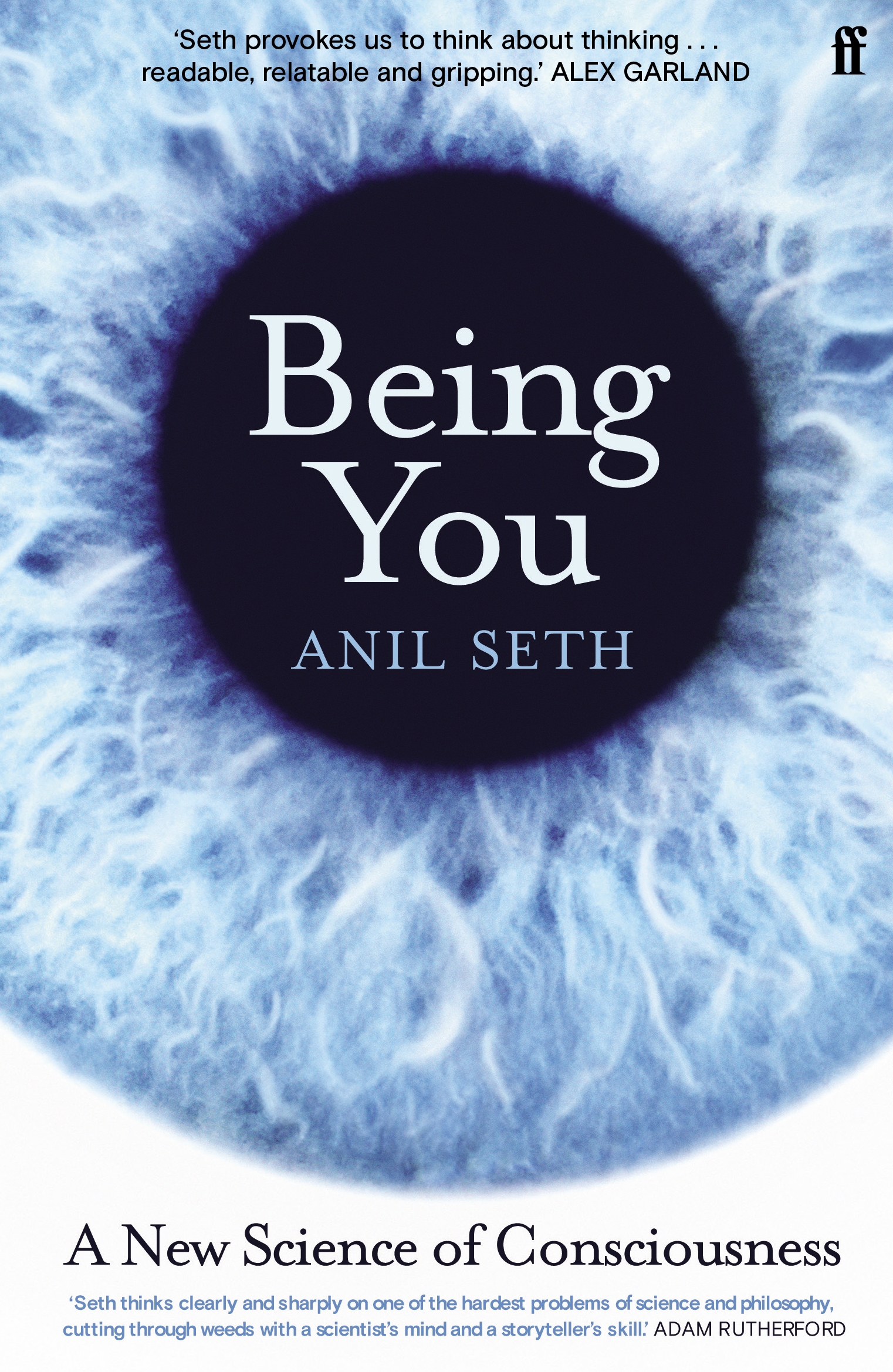
Being You: A New Science of Consciousness
Overview
In Being You, neuroscientist Anil Seth proposes that consciousness is best understood not as a mystery to be “solved” but as a natural phenomenon to be explained — much like life itself. His central thesis is that our perceptual experiences are “controlled hallucinations”: the brain’s best predictions about the causes of sensory signals, continuously refined by prediction error. Seth extends this predictive processing framework from perception to the experience of selfhood, emotions, and volition, arguing that the self is itself a perceptual construct generated by the brain to regulate the body.
Key Concepts
The Predictive Brain
- Top-down predictions: The brain does not passively receive sensory input. Instead, it constantly generates predictions about what it expects to encounter, and compares these with actual sensory signals. What we consciously perceive is the brain’s prediction, not raw data from the world.
- Prediction error: When predictions fail to match incoming signals, a prediction error is generated. This error propagates upward through the cortical hierarchy, updating the internal model. Perception is thus a process of continual Bayesian inference.
- Controlled hallucination: Because perception is dominated by top-down predictions rather than bottom-up signals, Seth calls it a “controlled hallucination.” The hallucination is controlled because it is constrained by sensory evidence; it becomes uncontrolled in dreams, psychedelic states, or psychosis.
The Real Problem of Consciousness
- Sidestepping the hard problem: Rather than tackling Chalmers’ “hard problem” (why physical processes give rise to subjective experience at all), Seth focuses on the “real problem”: explaining, predicting, and controlling the specific properties of conscious experiences — their structure, content, and dynamics.
- Explanatory correlates: Seth argues that once we can explain why a particular pattern of brain activity corresponds to seeing red (and not blue, or nothing), the hard problem may dissolve — just as the “mystery” of life dissolved with biochemistry without anyone pointing to a single moment where life was “explained.”
Perception and the World
- Perceptual presence: Objects feel “real” and “present” not because our brain makes a photographic copy, but because the brain predicts the sensory consequences of possible actions (e.g., how a cup’s appearance would change if you moved your head). The richness of the prediction gives rise to the sense of a solid, present world.
- Inside-out perception: Seth inverts the common intuition. We do not see the world as it is; we see it as it is useful for us. Color, shape, and even the solidity of objects are constructs shaped by evolutionary utility, not faithful representations of physics.
The Constructed Self
- The bodily self (interoception): The experience of being a body is itself a prediction. The brain models the internal physiological state of the body — heart rate, breathing, gut signals — generating what Seth calls the “interoceptive self.” Emotions arise from the brain’s predictions about internal bodily states.
- The perspectival self: The sense of having a first-person viewpoint located inside a body is another layer of predictive modeling, not a given.
- The volitional self: Even the feeling of free will — “I chose to do this” — is a post-hoc perceptual inference, a prediction about the causes of one’s own actions.
- Dissolution of self: In meditation, anesthesia, or psychedelic experiences, layers of the self-model can be selectively disrupted, revealing that the unified “I” is a construction rather than a fundamental entity.
Personal Reflection
When I read this book, and the idea of top-down preditictions and bottom-up signals clicked for me, it was like a lightbulb went off. The topic of perception is what mostly interested me and has influence me heavily (together with Somatic Markers and Umwelt) in how I see the world. The idea that we don’t see the world as it is, but as it is useful for us, is a powerful one. It has made me more aware of my own perceptual biases and how they shape my experience of reality.
Related Books
- The Hidden Spring - Both map consciousness onto predictive processing but disagree on the locus (cortex vs brainstem)
- Active Inference - The mathematical formalism behind the “controlled hallucination” Seth describes
- Looking for Spinoza - Damasio’s somatic-marker hypothesis prefigures Seth’s interoceptive model of selfhood
Parent: Books