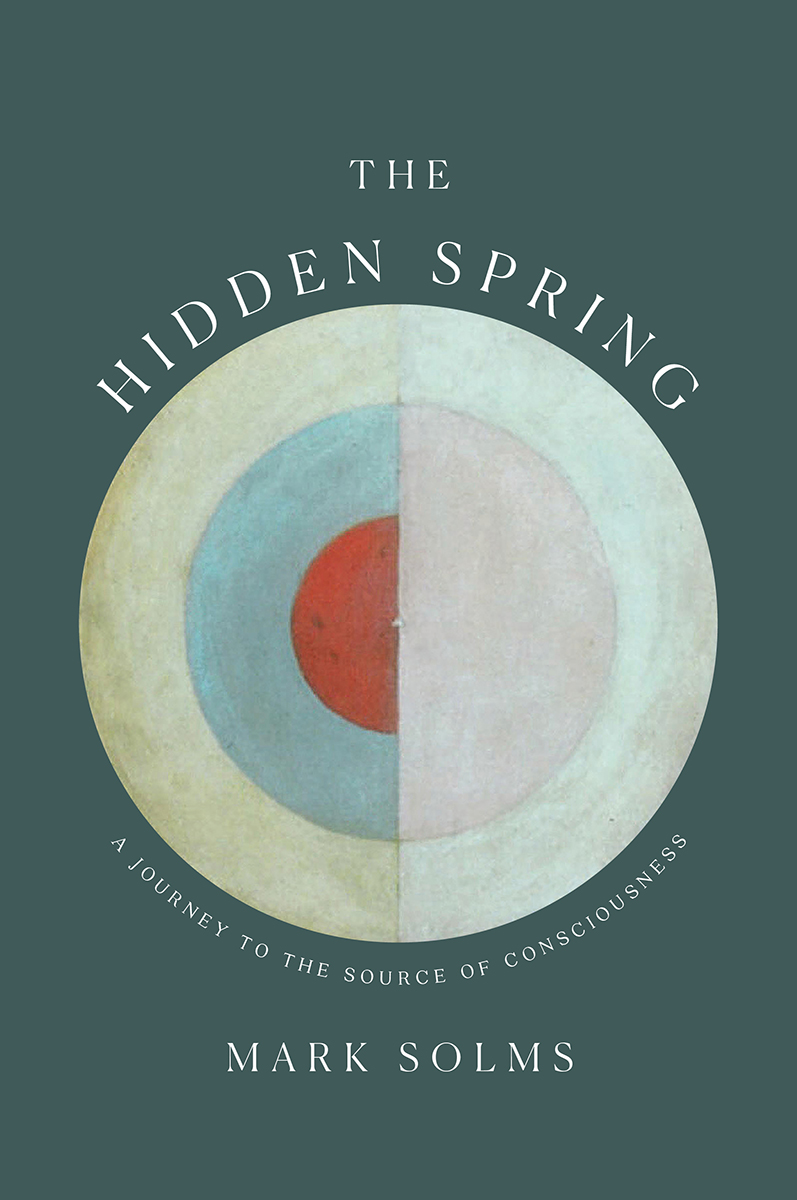
The Hidden Spring: A Journey to the Source of Consciousness
Overview
In The Hidden Spring, neuropsychologist Mark Solms argues that consciousness does not originate in the cerebral cortex — as mainstream neuroscience assumes — but in the brainstem, one of the most ancient structures in the vertebrate brain. By synthesizing clinical evidence from patients with massive cortical damage, insights from Jaak Panksepp’s affective neuroscience, and Karl Friston’s free energy principle, Solms builds a case that feeling is the foundational layer of consciousness. The book can be read as an extension and synthesis of the work of Damasio (emotion as core to consciousness) and Seth/Friston (predictive processing), applied specifically to the question of where consciousness begins.
Key Concepts
Consciousness in the Brainstem
- The cortical assumption overturned: The dominant view locates consciousness in cortical activity (vision in the occipital cortex, language in Broca’s/Wernicke’s areas). Solms counters this with evidence from hydrocephalic children who possess almost no cortex yet display clear signs of awareness, emotion, and social engagement.
- The reticular activating system (RAS): The brainstem’s RAS is the master switch of consciousness — damage to it produces coma, while cortical lesions do not eliminate subjective experience. This implies the cortex elaborates conscious content but does not generate it.
- Evolutionary depth: Because the brainstem is conserved across vertebrates (fish, reptiles, mammals), Solms suggests that some form of sentience is far more widespread in the animal kingdom than we typically assume.
Affect as the Core of Consciousness
- Feelings first: Drawing on Panksepp’s seven primary affective systems (SEEKING, RAGE, FEAR, LUST, CARE, PANIC/GRIEF, PLAY), Solms argues that raw emotional states — not cognitive representations — are the most basic form of subjective experience.
- The valence dimension: Consciousness at its simplest is a felt sense of good or bad — an organism’s evaluation of whether its current state supports or threatens survival. This valence signal is what makes experience matter to the experiencer.
- Clinical evidence: Patients with cortical lesions can lose specific cognitive abilities (language, face recognition) while retaining emotional awareness; patients with brainstem damage lose consciousness entirely.
The Free Energy Principle Applied
- Prediction error as feeling: Solms maps Friston’s free energy principle onto his brainstem model. The brainstem monitors homeostatic variables (temperature, blood chemistry, arousal) and generates prediction errors when they deviate from set points. These prediction errors are felt as emotions — hunger, thirst, pain, pleasure.
- Precision weighting: The intensity of an emotion reflects the precision (confidence) the brain assigns to a prediction error. High-precision deviations from homeostatic targets produce strong feelings that demand action.
- Active inference: The organism acts on the world to resolve prediction errors and return to homeostasis, making consciousness fundamentally action-oriented rather than passive observation.
Implications
- Strike three against humanity: Solms frames the demotion of cortical consciousness as the third great humiliation — after Galileo (Earth is not the center) and Darwin (humans are not separate from animals), we now learn that the “higher” cortex is not the seat of our innermost experience.
- The hard problem reframed: Rather than asking how physical matter gives rise to subjective experience (Chalmers’ hard problem), Solms asks why certain biological states feel like something. His answer: feeling is what precision-weighted homeostatic prediction error is, viewed from the inside.
Personal Reflection
[To be added]
Related Books
- Being You - Both map consciousness onto predictive processing but disagree on the locus (brainstem vs cortex)
- Looking for Spinoza - Solms explicitly extends Damasio’s affect-first thesis with Friston’s maths
- Active Inference - The formal framework Solms draws on to explain feelings as precision-weighted prediction errors
Parent: Books