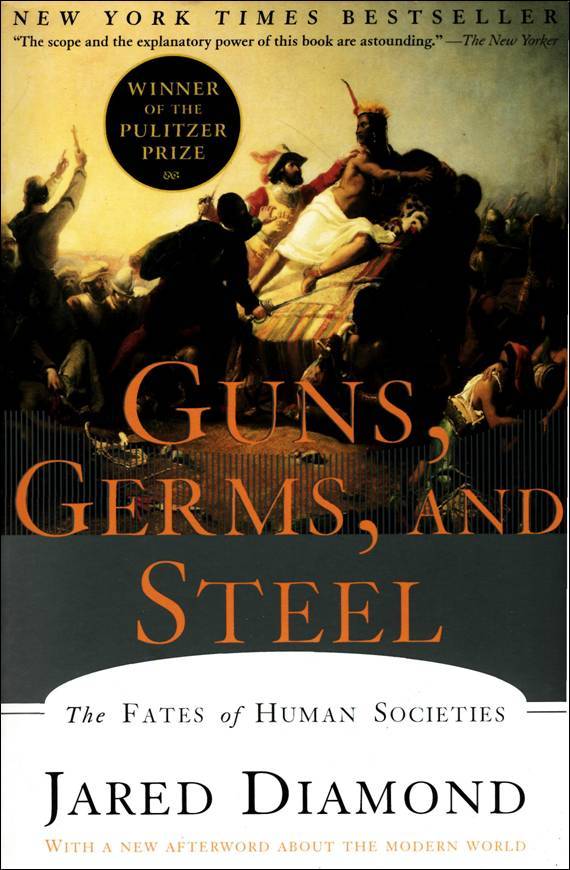
Guns, Germs, and Steel: The Fates of Human Societies
Overview
Jared Diamond asks why Eurasian civilisations came to dominate and displace others, and argues that the answer lies not in biological differences between peoples but in the unequal distribution of domesticable plants and animals, continental axis orientations, and resulting cascades of food surplus, population density, technology, and epidemic disease. The book synthesises archaeology, evolutionary biology, linguistics, and epidemiology into a single explanatory framework that traces how geographic starting conditions set in motion divergent trajectories of societal complexity stretching back to the end of the last Ice Age.
Key Concepts
Geographic Determinism and Domestication
- The Fertile Crescent advantage — of the world’s 56 large-seeded wild grasses suitable for domestication, 32 occurred in the Mediterranean and Near East; similarly, 13 of the 14 large domesticable mammals (horse, cow, sheep, goat, pig, etc.) were native to Eurasia, giving that continent a head start in agriculture
- The domestication bottleneck — only a tiny fraction of wild species meet the criteria for domestication (diet, growth rate, temperament, social structure, breeding in captivity); continents lacking qualifying candidates (sub-Saharan Africa, the Americas, Australia) could not independently develop agriculture on the same timeline
- Food production as engine — agriculture generates caloric surpluses that support non-farming specialists (artisans, soldiers, scribes, priests), enabling technological innovation, political centralisation, and literacy — the compound advantages Diamond calls “proximate factors”
Continental Axes and Diffusion
- East–west vs. north–south — Eurasia’s predominantly east–west axis means that crops, livestock, and technologies could spread across thousands of kilometres at similar latitudes without encountering radically different climates; the Americas and Africa, oriented north–south, impose climatic barriers (deserts, tropical zones) that impede diffusion
- Speed of spread — the Fertile Crescent’s founder crops (wheat, barley, lentils) reached Europe, North Africa, and South Asia within a few thousand years; maize took far longer to move from Mesoamerica to the Andes because of the north–south axis and intervening tropics
- Technology transfer — writing, metallurgy, and the wheel followed similar diffusion patterns; societies connected by accessible overland routes innovated faster because they could adopt and adapt each other’s inventions
Germs and Epidemic Disease
- Zoonotic origins — long coexistence with domesticated animals exposed Eurasian populations to zoonotic diseases (smallpox from cattle, influenza from pigs, measles from rinderpest), enabling the evolution of partial immunity over millennia
- Epidemic as weapon — when Europeans contacted populations with no history of animal domestication (the Americas, Australia, Pacific islands), their diseases preceded and often exceeded military conquest in lethality; Diamond estimates that up to 95% of pre-Columbian Native Americans died from Old World pathogens
- Population density and disease ecology — epidemic diseases require large, dense populations to sustain chains of transmission; they could not have evolved in small, dispersed hunter-gatherer bands, linking disease ecology directly back to agricultural surplus and urbanisation
Political Complexity and Conquest
- From bands to states — Diamond traces the progression from small egalitarian bands (≤ dozens) through tribes, chiefdoms, and states (millions), each step enabled by increased population, surplus, and information management
- Writing, bureaucracy, and military organisation — literate states could administer taxes, mobilise armies, and transmit orders across distances, giving them decisive advantages over non-literate societies in conflict
- The ultimate vs. proximate distinction — Diamond insists that guns, germs, and steel are proximate causes of European expansion; the ultimate cause is biogeographic luck — which continents happened to have the right wild species and the right geography for their rapid spread
Personal Reflection
[To be added]
Related Books
- The Story of the Human Body - Lieberman picks up where Diamond leaves off: how agriculture reshaped the human body
- The Invention of Nature - Humboldt was among the first to link geography to life distribution — the intellectual precursor to Diamond’s argument
- The Extended Selfish Gene - Dawkins’ gene-level evolution provides the mechanism behind the domestication processes Diamond describes
Parent: Books