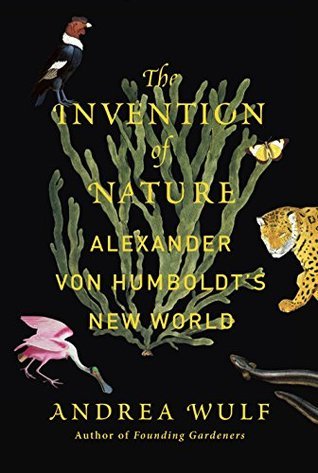
The Invention of Nature: Alexander von Humboldt’s New World
Overview
Andrea Wulf reconstructs the life of Alexander von Humboldt (1769–1859), the Prussian naturalist whose expeditions across South America, Central Asia, and Europe transformed how humanity perceives the natural world. Wulf argues that Humboldt invented our modern concept of nature as a single, interconnected web of living and non-living forces — an idea so deeply absorbed into Western thought that its originator has been largely forgotten. The book also traces Humboldt’s enormous influence on subsequent thinkers, from Darwin and Thoreau to Muir and Haeckel, positioning him as the intellectual ancestor of ecology and environmentalism.
Key Concepts
Nature as an Interconnected Whole
- Naturgemälde — the web of life — Humboldt’s famous cross-section diagram of Chimborazo depicted vegetation zones, temperature, atmospheric pressure, and geology on a single page, visually encoding the idea that all natural phenomena are linked
- Isotherms and biogeography — by plotting lines of equal temperature across the globe, Humboldt showed that climate — not longitude — governs the distribution of plant and animal communities, founding the discipline of biogeography
- Systems thinking before systems science — Humboldt insisted that isolating a single variable misses the point; he measured everything simultaneously (altitude, humidity, soil chemistry, species counts) to reveal patterns that siloed disciplines could not
Early Environmentalism
- Human-caused climate change — observing how colonial deforestation around Lake Valencia in Venezuela lowered water levels and altered local rainfall, Humboldt became the first scientist to describe anthropogenic climate disruption, decades before the concept entered mainstream science
- Ecological consequences of colonialism — Humboldt documented how monoculture plantations, irrigation diversions, and mining degraded ecosystems, explicitly linking economic exploitation to environmental destruction
- Conservation ethic — his writings argued that nature has intrinsic value beyond its utility to humans, seeding ideas that would later crystallise into the conservation movement through followers like John Muir
The Interdisciplinary Method
- Science and aesthetics — Humboldt believed that emotional and sensory experience of nature was as important as measurement; his multi-volume “Cosmos” combined rigorous data with lyrical prose, inspiring both scientists and artists
- Collaborative knowledge — he shared data freely, corresponded with hundreds of researchers, and funded other scientists’ work, prefiguring the open-science ethos
- Influence on Darwin — Darwin carried Humboldt’s “Personal Narrative” aboard the Beagle; Humboldt’s biogeographic observations directly influenced Darwin’s thinking about species distribution and adaptation
Legacy and Intellectual Lineage
- Haeckel and the birth of ecology — Ernst Haeckel, a Humboldt devotee, coined the term “ecology” (Ökologie) to describe the science of relationships between organisms and their environment, formalising Humboldt’s holistic vision
- Thoreau and American transcendentalism — Thoreau’s Walden was shaped by Humboldtian ideas about nature’s unity, blending empirical observation with philosophical reflection
- A forgotten giant — Wulf argues that Humboldt’s declining fame in the English-speaking world is partly due to anti-German sentiment during the World Wars, despite more places on Earth being named after him than any other person
Personal Reflection
[To be added]
Related Books
- The Secret Network of Nature - Wohlleben’s ecological interconnection is a direct descendant of Humboldt’s holistic view
- A Brief History of Earth - Knoll covers the deep time behind the landscapes Humboldt explored
- Dirt to Soil - Brown’s regenerative agriculture embodies Humboldt’s insight that nature is a web
Parent: Books